The first Stella Marrs postcard I ever saw was a gift from an older cousin one Christmas when I was in high school and had started to become politically conscious. I loved the postcard, laminated it with packaging tape and safety-pinned it to my back pack.

I didn't see her postcards/art again until I visited Left Bank anarchist bookstore in Seattle 3 years ago. There I picked up a handful more:


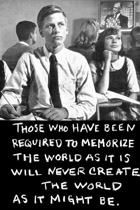
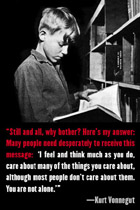
(Including another that said "This machine kills fascists" printed underneath a pencil on a red background.)
According to Stella Marrs' website, www.stellamarrs.com, she is an artist living and making art out of Olympia, Washington. There was no simple biography on her website, just an INTERVIEW of STELLA MARRS by Everett True. The following are excerpts:
. . . if girls could just make things and see themselves reflected in what they made, and then trade it for money, that could be a window to empowerment about alternatives for economic survival. Because if you get to live outside the normal system you just might have a chance for a different vision, which could mean ultimately an alternative voice.
. . .
The "girl" work is from a deep place that tries to counter this culture's shackles on girls. It is a reaction to the ridiculous taboos on girls being too silly and friendly with each other, having too much fun, or having a strong viewpoint and sense of self worth and being able to articulate it.
I lived in Japan at age 10. When we came back to the states I had a good girlfriend with a Japanese mom. We would walk around the playground holding hands. I remember we would get all this negative response to that innocent and joyful gesture. I knew it was okay in Japan for girls our age to do this. Why was it so taboo here? Why were girls my age being restricted in this way? It pissed me off then. In some way the girl work tries to lay down girl action as the status quo.
I lived in Japan at age 10. When we came back to the states I had a good girlfriend with a Japanese mom. We would walk around the playground holding hands. I remember we would get all this negative response to that innocent and joyful gesture. I knew it was okay in Japan for girls our age to do this. Why was it so taboo here? Why were girls my age being restricted in this way? It pissed me off then. In some way the girl work tries to lay down girl action as the status quo.
. . .
After college I made hundreds of different paintings,products,and events. I never put my name on anything during that period, I preferred to think of it all as some sort of warm up exercise for what I was really going to do. I finally settled on using my name on the back of postcards because I realized I better accept this medium by the default since I could afford to start manufacturing it, it was endlessly a challenge to come up with a new design for each image, it could be educational, and I could travel and sell it on public transportation because it was small and I didn't have a car.
Is it possible to make a living from postcards?
Is it possible to make a living selling bubble gum?
I wonder how to answer that. I am twenty years into this. When I think back at how it took every possible late night, and bit of luck, never accepting no as an answer, and the efforts of many brilliant people contributing, I realize that all that work, that type of perseverance could have been applied to anything and probably have succeed. Do you really want to work that hard to make a living selling bubble gum?
But here is the other critical lucky piece of being in business.
I have had the amazing good fortune of working with Sean Tejaratchi who is a graphic punk genius. Much of what has been printed by "Stella Marrs" is the gift of his moral designs, and unfailing humor that is either completely off the wall or inspired social criticism.
What is your motivation? Why do you do what you do?
I went through basic training in the U.S. military at age 17 for 6 weeks and then was "honorably" discharged. I was there for the same reason that 99% of the women in my platoon were- they had nowhere to go, no other economic or personal options for survival. Basic training is a brutally destructive force to human will and cultivating any sense of personal responsibility to an individual vision. Which is the whole point of basic, to erase your sense of self to make a you part of the killing machine. To make sure that all soldiers will first and foremost blindly FOLLOW THEIR CHAIN OF COMMAND. Witnessing the efficiency and scale of this organization set up a reaction in me where I realized that ANY ACT OF CONSTRUCTION was in itself of HUGE VALUE. This was a very forgiving view for me to have about myself and art making. It freed me from the destructive self judgment that happens when you start something and it isn't "great" yet.
_________________________________________________________________________________________________
I wanted to respond to Stella Marrs talking about using postcards as a medium. I have a lot of respect for people who create politically-motivated art that looks good and who are able to support themselves doing so. Of course, what "looks good" to me may not be subtle enough for other people, but I do think Marrs is an artist who balances strong aesthetics with a simple message that gets me to think critically about the problems in our society. Before finding out about Marrs, I guess I never assumed that an artist could start off and maintain their career for 20 years by creating a line of postcards-- something I hope inspires other low-income artists to not give up hope about making it with what they can afford to do. I think postcards are attractive because they make art affordable and easily transportable, and takes something that is traditionally a kitschy but practical object and gives it political and artistic potential. Postcards are interesting to me because their dimensions are so small and our culture sees fine art as existing in much larger physical spaces-- which means that Marrs has opted to position herself outside of the mainstream art world. I also enjoy the fact that the postcards have a sweet, 50s vintage, Modern art feel. When Marrs talk about liking postcards as a medium and about how her name appears on the back, I assume she is saying that she likes how the image/design stands alone without her name drawing attention away from the design and message (which to me is a sign of humility as well as a display of her priorities). Also, when she said it was an endless challenge to come up with a new design, it reminded me of Sheena Matheiken's "The Uniform Project" in terms of rules and limits inspiring creativity (that we saw on Zimmermann's blog) and how artists make up projects and exhibits based on new sets of rules and confines just to give themselves a structural framework by which to create in directed bursts of spontaneity.


No comments:
Post a Comment